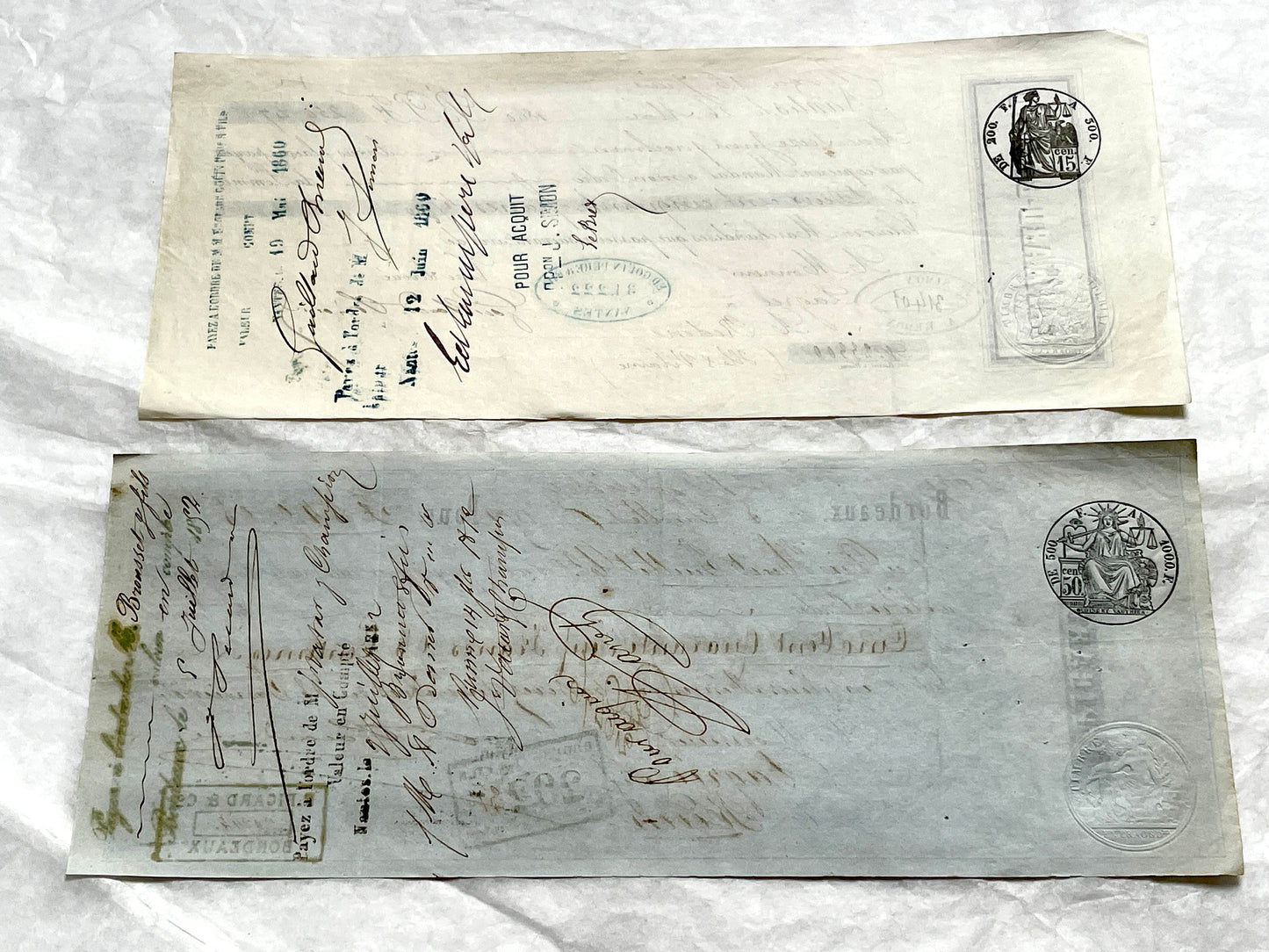


Mid 19th - Set of 6 French Exchange Letters - Historical Commercial Documents
Mid 19th - Set of 6 French Exchange Letters - Historical Commercial Documents
Sold
Taxes included.
Shipping calculated at checkout.
🕰️ Vintage from the Mid 19th century
🤍 Handpicked by Vincent
📐 Dimensions: 20x9 cm (7.9x3.5 in)
📦 Carefully packed and shipped worldwide
🔒 Secure Shopify checkout · Credit cards, Apple Pay, Shop Pay, PayPal
🧾 Shipping & returns details
ℹ️ Shipping costs depend on destination and weight and are always shown clearly before payment.
Couldn't load pickup availability
This unique collection features a set of 6 French exchange letters, dating from the Mid 19th century. These original historical documents offer a tangible connection to 19th-century European commerce and the intricate financial practices of the era, handwritten in French.
In the 19th century, exchange letters, also known as bills of exchange, served as crucial financial instruments. They facilitated trade by acting as a promise of payment, often across different cities or countries, allowing merchants to conduct business without the immediate transfer of physical currency. A drawer would instruct a drawee to pay a certain sum to a third party (the payee) at a future date or on demand. For example, one letter states: 'Bordeaux, le 10 Janvier 1860... veuillez payer pour cette lettre de change la somme de Mille francs' (Bordeaux, January 10, 1860... please pay by this sole bill of exchange the sum of One thousand francs). The letters in this set display various handwritten notations, commercial stamps, and company names from cities like Nantes and Bordeaux, illustrating the widespread use of these financial tools.
In the 19th century, exchange letters, also known as bills of exchange, served as crucial financial instruments. They facilitated trade by acting as a promise of payment, often across different cities or countries, allowing merchants to conduct business without the immediate transfer of physical currency. A drawer would instruct a drawee to pay a certain sum to a third party (the payee) at a future date or on demand. For example, one letter states: 'Bordeaux, le 10 Janvier 1860... veuillez payer pour cette lettre de change la somme de Mille francs' (Bordeaux, January 10, 1860... please pay by this sole bill of exchange the sum of One thousand francs). The letters in this set display various handwritten notations, commercial stamps, and company names from cities like Nantes and Bordeaux, illustrating the widespread use of these financial tools.
Explore more from our antique documents collection .
💬 Questions before or after purchase? We’re always happy to help.