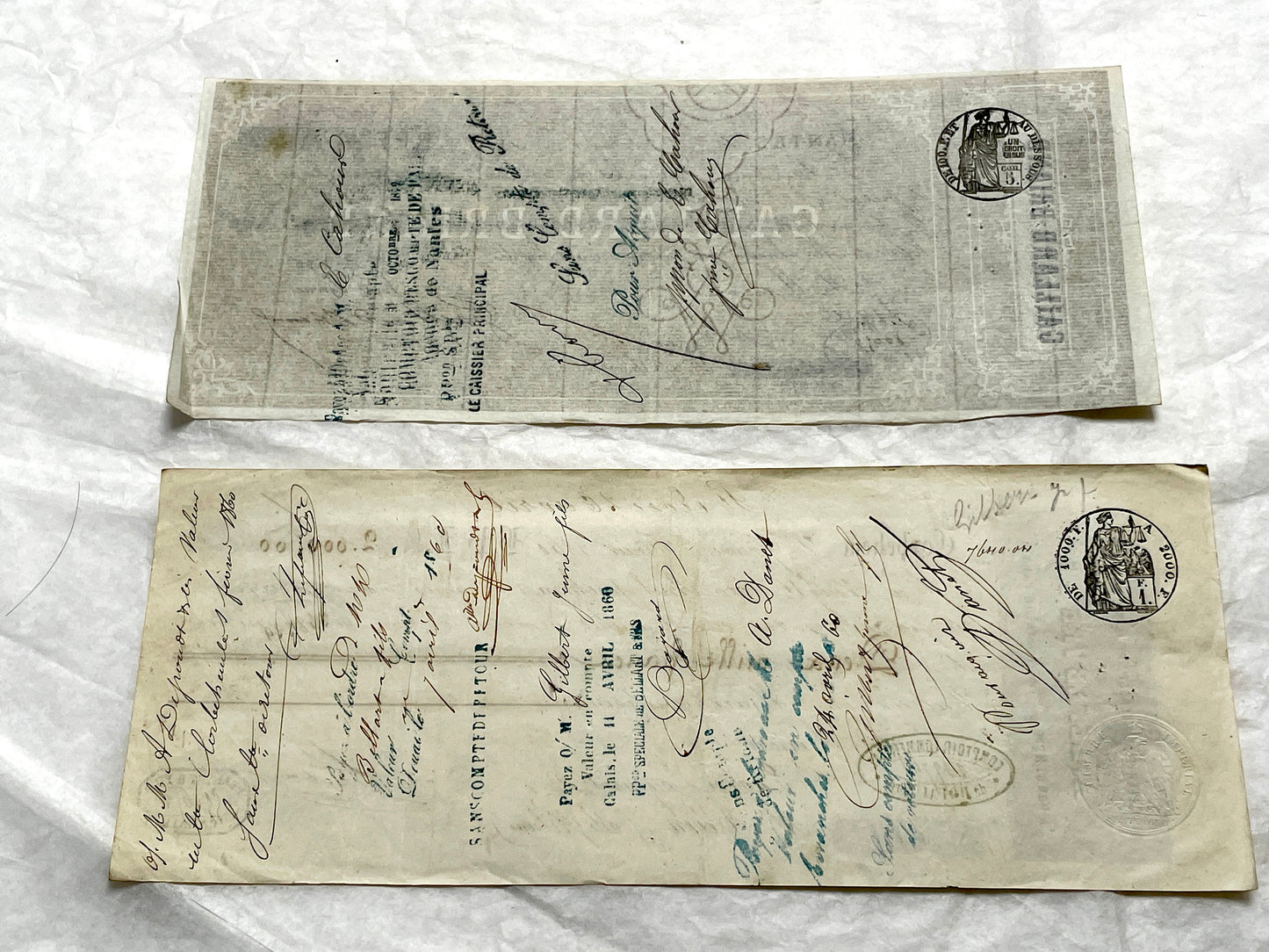


Mid 19th - Set of 6 French Bills of Exchange - 19th Century Historic Letters
Mid 19th - Set of 6 French Bills of Exchange - 19th Century Historic Letters
Sold
Taxes included.
Shipping calculated at checkout.
🕰️ Vintage from the Mid 19th century
🤍 Handpicked by Vincent
📐 Dimensions: 20x9 cm (7.9x3.5 in)
📦 Carefully packed and shipped worldwide
🔒 Secure Shopify checkout · Credit cards, Apple Pay, Shop Pay, PayPal
🧾 Shipping & returns details
ℹ️ Shipping costs depend on destination and weight and are always shown clearly before payment.
Couldn't load pickup availability
This set of 6 French Bills of Exchange letters offers an authentic glimpse into 19th-century French financial history. Each document is a genuine record, written in French, illustrating the complex commercial transactions of the era. This collection represents a key piece of historical paper from different decades of the 19th century.
Bills of exchange, or 'lettres de change' in French, were fundamental instruments in commerce during the 19th century. They served as a written order from one person or company (the drawer) to another (the drawee) to pay a fixed sum of money to a third party (the payee) at a specified future date or on demand. This system facilitated long-distance trade and credit, allowing merchants to conduct transactions without the physical transfer of large amounts of currency, significantly aiding economic development and cross-border commerce. For example, one letter states: 'NANTES le 30 Juillt 1871. Au dix août prochain, il vous plaira de payer... la somme de Cent soixante treize francs 60 centimes...' (NANTES, July 30, 1871. On the tenth of August next, please pay... the sum of one hundred seventy-three francs 60 centimes...). These letters feature various mercantile stamps and handwritten entries from different French localities, offering an insight into the commercial networks and financial practices of the time. They are suitable for collectors of historical ephemera and financial documents.
Bills of exchange, or 'lettres de change' in French, were fundamental instruments in commerce during the 19th century. They served as a written order from one person or company (the drawer) to another (the drawee) to pay a fixed sum of money to a third party (the payee) at a specified future date or on demand. This system facilitated long-distance trade and credit, allowing merchants to conduct transactions without the physical transfer of large amounts of currency, significantly aiding economic development and cross-border commerce. For example, one letter states: 'NANTES le 30 Juillt 1871. Au dix août prochain, il vous plaira de payer... la somme de Cent soixante treize francs 60 centimes...' (NANTES, July 30, 1871. On the tenth of August next, please pay... the sum of one hundred seventy-three francs 60 centimes...). These letters feature various mercantile stamps and handwritten entries from different French localities, offering an insight into the commercial networks and financial practices of the time. They are suitable for collectors of historical ephemera and financial documents.
Explore more from our antique documents collection .
💬 Questions before or after purchase? We’re always happy to help.