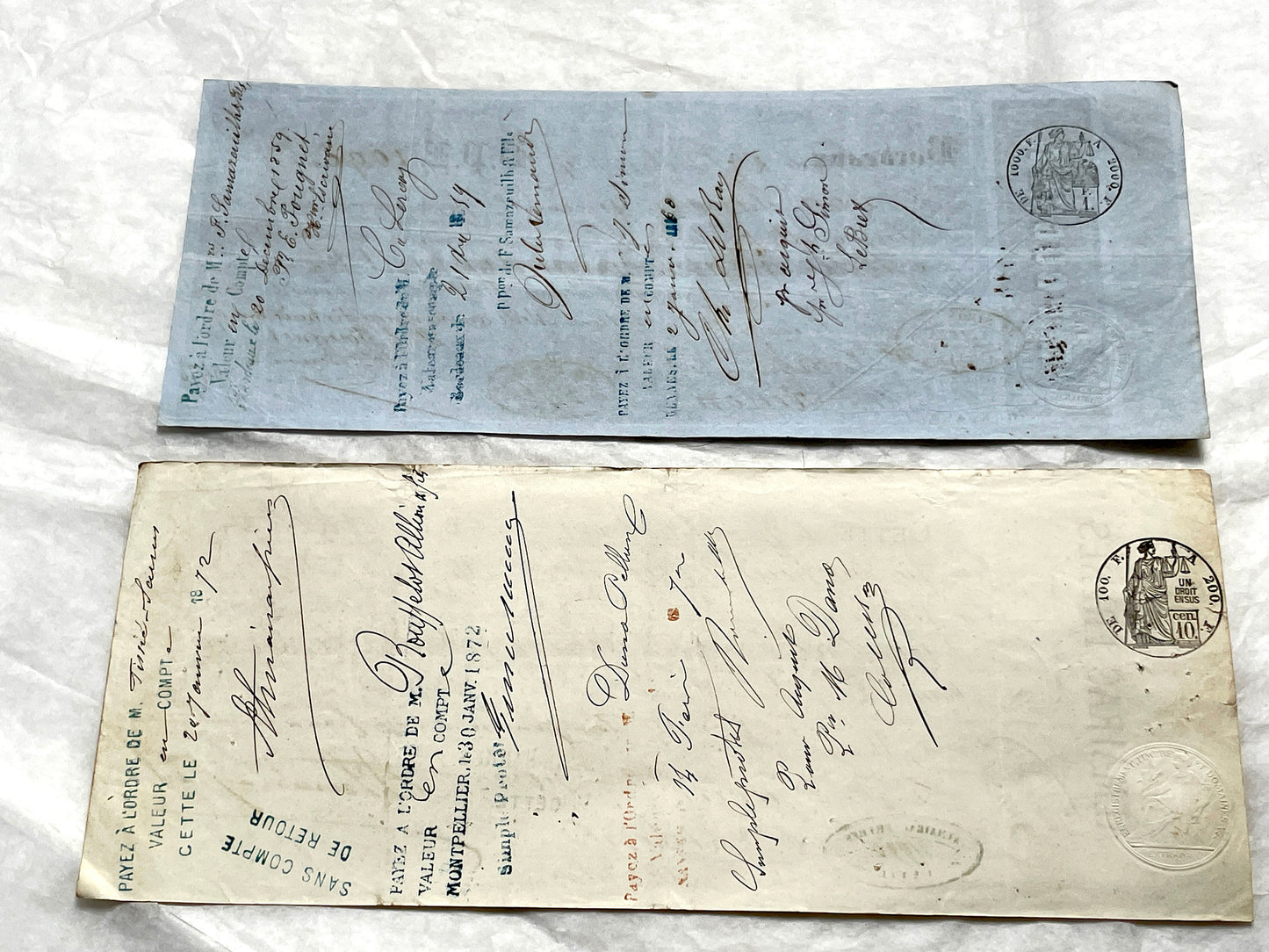


Late 19th Century - Set of 6 French Exchange Letters - Financial Documents
Late 19th Century - Set of 6 French Exchange Letters - Financial Documents
Regular price
€9,60 EUR
Regular price
Sale price
€9,60 EUR
Unit price
per
Taxes included.
Shipping calculated at checkout.
🕰️ Vintage from the Late 19th century
🤍 Handpicked by Vincent
📐 Dimensions: 20x9 cm (7.9x3.5 in)
📦 Carefully packed and shipped worldwide
🔒 Secure Shopify checkout · Credit cards, Apple Pay, Shop Pay, PayPal
🧾 Shipping & returns details
ℹ️ Shipping costs depend on destination and weight and are always shown clearly before payment.
Couldn't load pickup availability
This collection presents a set of 6 authentic French exchange letters, dating from the Mid to Late 19th Century (specifically 1859-1871). These vintage documents, written in French, offer a glimpse into historical financial practices and commerce. For example, one letter from Nantes states 'payer contre le présent, la somme' (pay against the present the sum), illustrating a common directive. Each letter features handwritten text and various official stamps and markings from the period.
In the 19th century, a letter of exchange (or bill of exchange) served as a critical financial instrument, acting as an instruction from one party (the drawer) to another (the drawee) to pay a specific sum to a third party (the payee) at a future date. These documents facilitated long-distance trade and financial transactions, often bypassing the physical transfer of currency, thereby reducing risks associated with transporting large sums of money. They were essential tools in the banking and merchant world, providing a verifiable record of debt and payment obligations between individuals and businesses across different cities in France. The cities of Bordeaux, Nantes, Paris, Cette, and Corbeil are noted on these particular examples.
In the 19th century, a letter of exchange (or bill of exchange) served as a critical financial instrument, acting as an instruction from one party (the drawer) to another (the drawee) to pay a specific sum to a third party (the payee) at a future date. These documents facilitated long-distance trade and financial transactions, often bypassing the physical transfer of currency, thereby reducing risks associated with transporting large sums of money. They were essential tools in the banking and merchant world, providing a verifiable record of debt and payment obligations between individuals and businesses across different cities in France. The cities of Bordeaux, Nantes, Paris, Cette, and Corbeil are noted on these particular examples.
Explore more from our antique documents collection .
💬 Questions before or after purchase? We’re always happy to help.