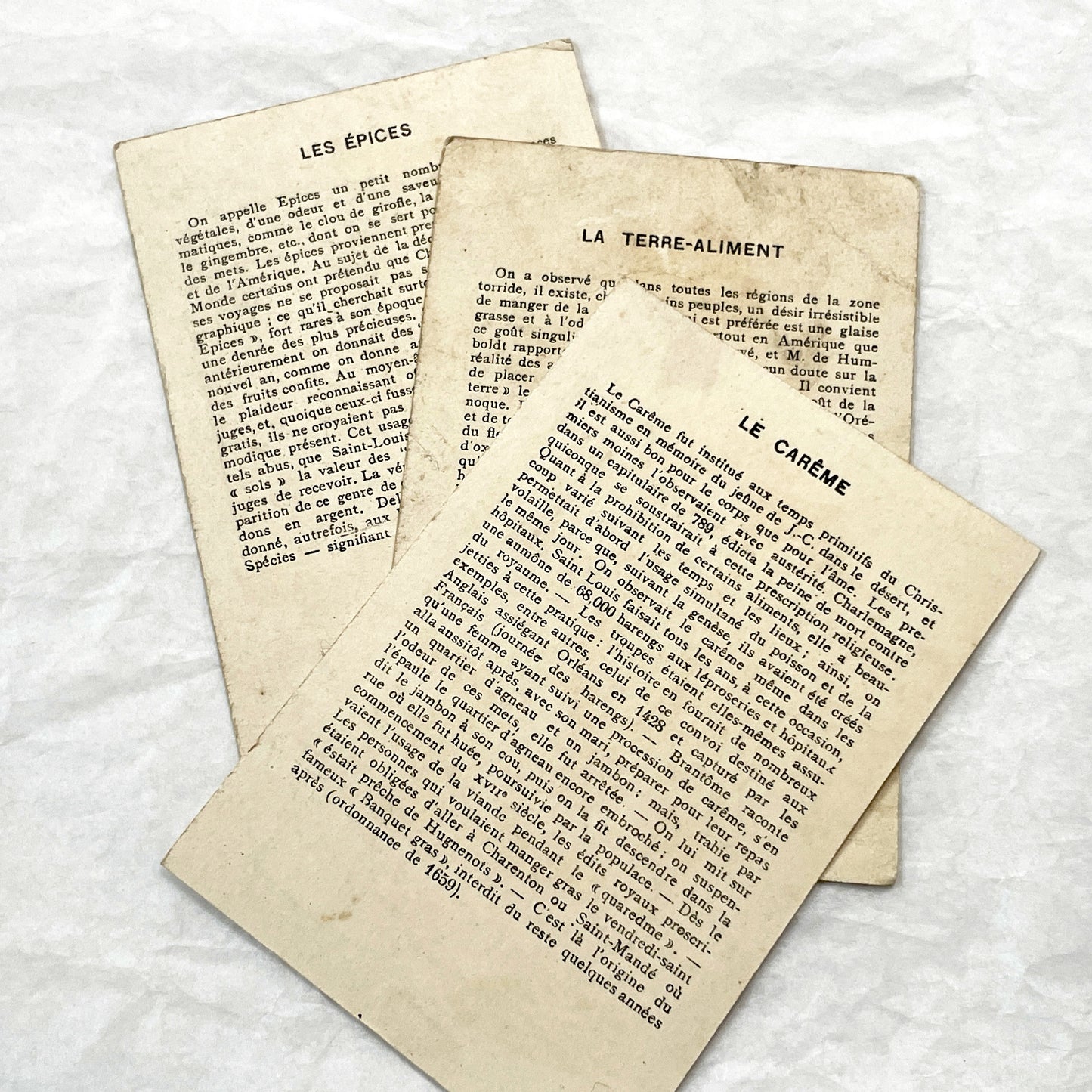


Late 19th - 3 Antique French Educational Chromo Cards - Anecdotal Food History Series - Cultural Vintage Ephemera Collectible Set
Late 19th - 3 Antique French Educational Chromo Cards - Anecdotal Food History Series - Cultural Vintage Ephemera Collectible Set
Regular price
€8,40 EUR
Regular price
Sale price
€8,40 EUR
Unit price
per
Taxes included.
Shipping calculated at checkout.
🕰️ Vintage from the Late 19th century
🤍 Handpicked by Vincent
📐 Dimensions: 10x7 cm (3.9x2.8 in)
📦 Carefully packed and shipped worldwide
🔒 Secure Shopify checkout · Credit cards, Apple Pay, Shop Pay, PayPal
🧾 Shipping & returns details
ℹ️ Shipping costs depend on destination and weight and are always shown clearly before payment.
Couldn't load pickup availability
This lot features three captivating Late 19th-century French chromo cards from the 'Histoire Anecdotique de l'Alimentation' (Anecdotal History of Food) series. These beautifully illustrated cards likely served as educational or promotional items, offering historical insights into food culture. Each piece presents a distinct, richly colored scene with a French title, exploring various facets of human interaction with food through engaging narratives, characteristic of the era's popular collecting trends.
One card is titled 'Le Carême' (Lent), subtitled '(Supplice d'une 'Marmiteuse')' (Punishment of a 'Stew-Eater'). It portrays a dramatic village scene where a woman, presumably a 'marmiteuse' for eating rich foods during Lent, is being chased by an angry crowd and dogs. Fish on the ground symbolize the traditional Lenten diet, vividly capturing a historical social commentary on dietary customs.
Another card, 'La Terre (Aliment)' (The Land (Food)), illustrates the primal connection to earth's bounty. The image depicts indigenous people, with a woman grinding grains or preparing food on a large stone, accompanied by a child. A basket filled with harvested produce in the foreground emphasizes the direct reliance on natural resources for sustenance, highlighting ancient food preparation and the origins of human diet.
The third card, 'Les Épices' (The Spices), also bears the text 'Cadeau d'Etrennes' (New Year's Gift). This illustration shows a man in period attire offering a gift, likely spices, to a woman and child in a noble setting. A branch with spice-bearing leaves symbolizes the exotic nature and historical value of spices, suggesting a narrative about their trade and role in social customs.
One card is titled 'Le Carême' (Lent), subtitled '(Supplice d'une 'Marmiteuse')' (Punishment of a 'Stew-Eater'). It portrays a dramatic village scene where a woman, presumably a 'marmiteuse' for eating rich foods during Lent, is being chased by an angry crowd and dogs. Fish on the ground symbolize the traditional Lenten diet, vividly capturing a historical social commentary on dietary customs.
Another card, 'La Terre (Aliment)' (The Land (Food)), illustrates the primal connection to earth's bounty. The image depicts indigenous people, with a woman grinding grains or preparing food on a large stone, accompanied by a child. A basket filled with harvested produce in the foreground emphasizes the direct reliance on natural resources for sustenance, highlighting ancient food preparation and the origins of human diet.
The third card, 'Les Épices' (The Spices), also bears the text 'Cadeau d'Etrennes' (New Year's Gift). This illustration shows a man in period attire offering a gift, likely spices, to a woman and child in a noble setting. A branch with spice-bearing leaves symbolizes the exotic nature and historical value of spices, suggesting a narrative about their trade and role in social customs.
Discover more in our antique chromos collection .
💬 Questions before or after purchase? We’re always happy to help.