

Early 19th - Dramatic Regency Era Engraving - Woman Reacting to a Will - French Historical Print - Emotional Interior Scene Art
Early 19th - Dramatic Regency Era Engraving - Woman Reacting to a Will - French Historical Print - Emotional Interior Scene Art
Regular price
€10,80 EUR
Regular price
Sale price
€10,80 EUR
Unit price
per
Taxes included.
Shipping calculated at checkout.
🕰️ Vintage from the Early 19th century
🤍 Handpicked by Vincent
📐 Dimensions: 16x10 cm (6.3x3.9 in)
📦 Carefully packed and shipped worldwide
🔒 Secure Shopify checkout · Credit cards, Apple Pay, Shop Pay, PayPal
🧾 Shipping & returns details
ℹ️ Shipping costs depend on destination and weight and are always shown clearly before payment.
Couldn't load pickup availability
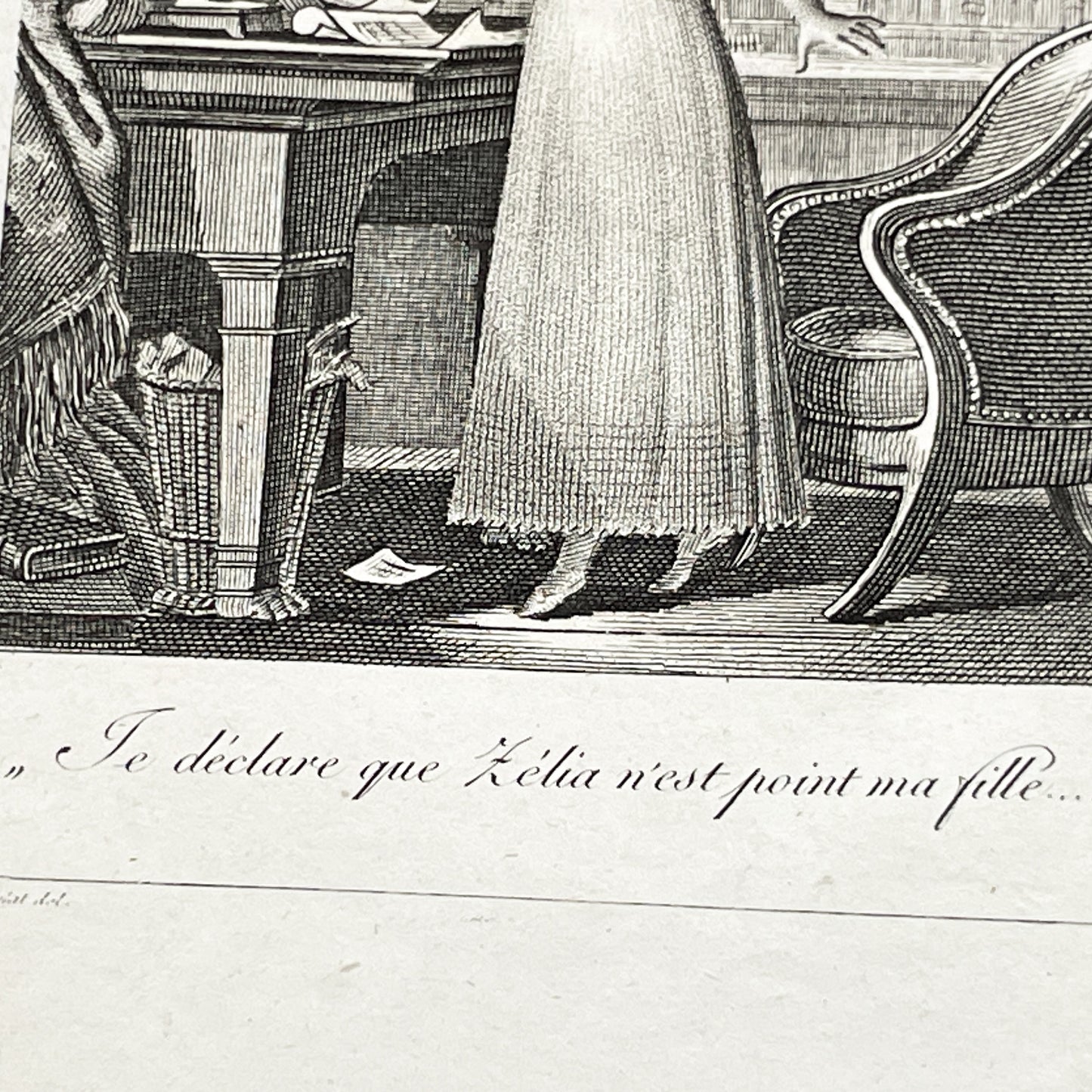
This historical print, titled 'LE TESTAMENT' (The Will), captures a poignant moment from the early 19th century. The scene unfolds within a richly appointed interior, likely a private study or library, indicated by the tall bookshelves filled with volumes that line the back wall. A meticulously crafted desk, adorned with papers and a writing implement, stands prominently in the foreground, suggesting a place of legal or scholarly work.
The central figure is a young woman, elegantly dressed in a high-waisted gown typical of the Regency or Empire era, with modest puffed sleeves. Her posture conveys deep emotion and distress, her hand is pressed to her chest, and her head is bowed, implying a profound shock or sorrow. She appears to have just encountered a significant document, which is the titular 'Will.' The dramatic intensity of the moment is underscored by the evocative caption at the bottom, 'Je déclare que Xélia n'est point ma fille...' (I declare that Xelia is not my daughter...), revealing a pivotal and heartbreaking revelation within the narrative.
This finely detailed engraving illustrates a narrative moment, typical of an illustration from a novel, a theatrical play, or a moral tale popular during the period. Such prints often served to depict dramatic human emotions and social situations, offering a visual window into the stories and concerns of the time, emphasizing themes of family, inheritance, and personal identity.
This engraving was designed by Charles Abraham Chasselat (1782–1843), a talented French painter and illustrator active during the early 19th century. It was engraved by one or more anonymous engravers working in Paris and published around 1815–1820, during the late Empire or early Restoration period. Prints of this type typically appeared in refined illustrated books such as Scènes de la vie domestique, Scènes intéressantes de la vie privée, or Contes moraux illustrés — popular collections that combined moral storytelling with delicate visual interpretation. These works reflected the sentimental and didactic spirit of the time, portraying scenes of virtue, affection, and everyday emotion within elegant bourgeois or domestic settings.
The central figure is a young woman, elegantly dressed in a high-waisted gown typical of the Regency or Empire era, with modest puffed sleeves. Her posture conveys deep emotion and distress, her hand is pressed to her chest, and her head is bowed, implying a profound shock or sorrow. She appears to have just encountered a significant document, which is the titular 'Will.' The dramatic intensity of the moment is underscored by the evocative caption at the bottom, 'Je déclare que Xélia n'est point ma fille...' (I declare that Xelia is not my daughter...), revealing a pivotal and heartbreaking revelation within the narrative.
This finely detailed engraving illustrates a narrative moment, typical of an illustration from a novel, a theatrical play, or a moral tale popular during the period. Such prints often served to depict dramatic human emotions and social situations, offering a visual window into the stories and concerns of the time, emphasizing themes of family, inheritance, and personal identity.
This engraving was designed by Charles Abraham Chasselat (1782–1843), a talented French painter and illustrator active during the early 19th century. It was engraved by one or more anonymous engravers working in Paris and published around 1815–1820, during the late Empire or early Restoration period. Prints of this type typically appeared in refined illustrated books such as Scènes de la vie domestique, Scènes intéressantes de la vie privée, or Contes moraux illustrés — popular collections that combined moral storytelling with delicate visual interpretation. These works reflected the sentimental and didactic spirit of the time, portraying scenes of virtue, affection, and everyday emotion within elegant bourgeois or domestic settings.
Explore more from our antique engravings collection .
💬 Questions before or after purchase? We’re always happy to help.