

Early 19th - Captivating French Engraving depicting a domestic scene from 'Le Petit Chien Noir' - Antique Print - Literary Illustration
Early 19th - Captivating French Engraving depicting a domestic scene from 'Le Petit Chien Noir' - Antique Print - Literary Illustration
Regular price
€10,80 EUR
Regular price
Sale price
€10,80 EUR
Unit price
per
Taxes included.
Shipping calculated at checkout.
🕰️ Vintage from the Early 19th century
🤍 Handpicked by Vincent
📐 Dimensions: 16x10 cm (6.3x3.9 in)
📦 Carefully packed and shipped worldwide
🔒 Secure Shopify checkout · Credit cards, Apple Pay, Shop Pay, PayPal
🧾 Shipping & returns details
ℹ️ Shipping costs depend on destination and weight and are always shown clearly before payment.
Couldn't load pickup availability
This captivating antique engraving, likely sourced from a literary work, illustrates a poignant domestic scene titled 'Le Petit Chien Noir' (The Little Black Dog). The illustration depicts a young woman seated on a chair, her bare foot resting on a small stool, with a distressed expression. Opposite her, a man kneels, cradling a small black dog in his arms, looking towards the woman's foot.
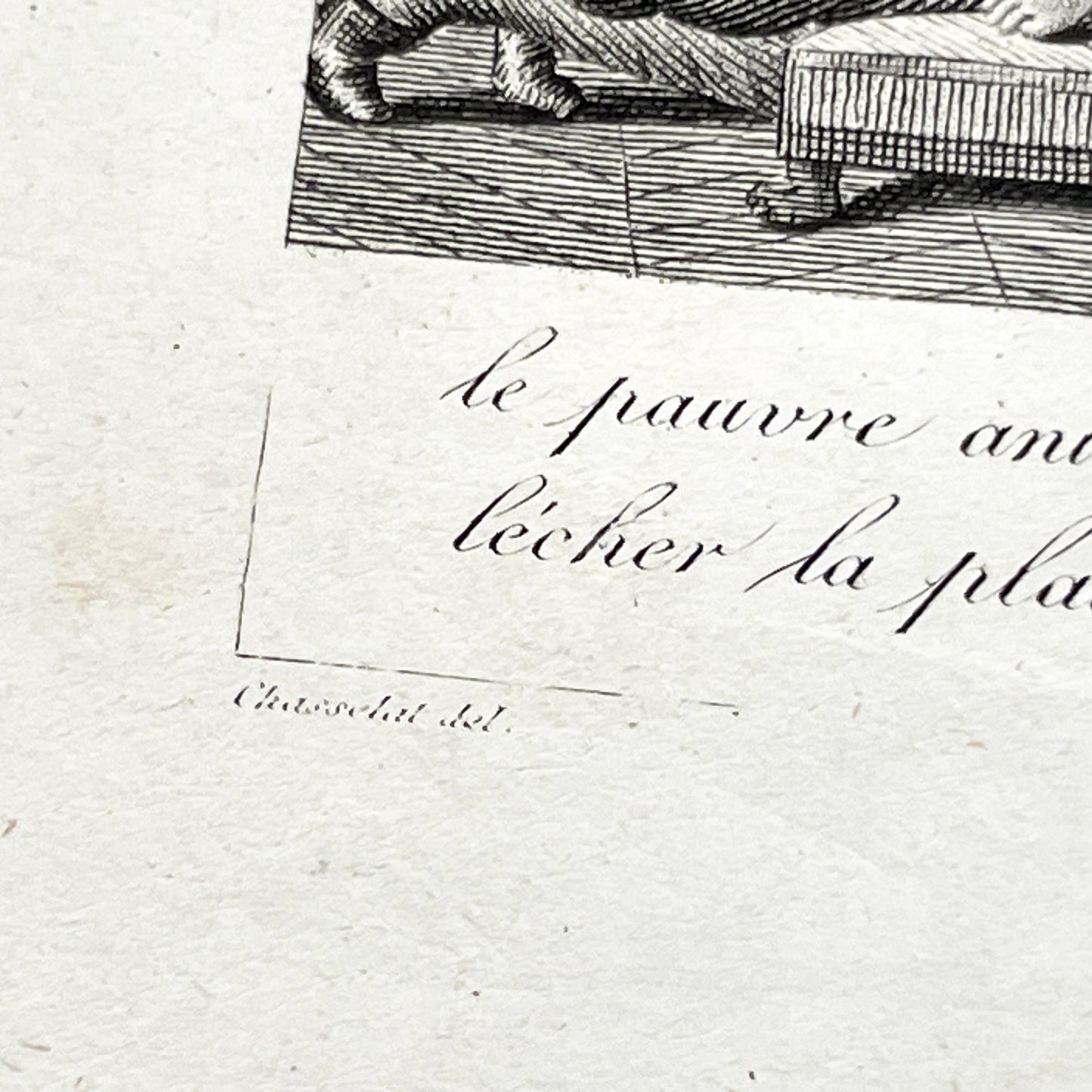
The focal point of the image is the interaction between the man, the dog, and the woman, suggesting an act of comfort or care towards her. The accompanying French text below the illustration, 'le pauvre animal......... se met à? lécher sa plaie?...........', translates to 'the poor animal......... begins to? lick its wound?...........' This line adds a narrative layer, implying the dog's role in comforting or healing, perhaps symbolically or literally, the woman's distress or injury. The scene is rich with emotion, conveyed through the characters' postures and expressions within a richly detailed interior setting, complete with drapes and a patterned wall.
This print serves as a charming glimpse into the visual storytelling traditions of the early 19th century, highlighting themes of companionship, care, and domestic life within a sentimental narrative framework.
This engraving was designed by Charles Abraham Chasselat (1782–1843), a talented French painter and illustrator active during the early 19th century. It was engraved by one or more anonymous engravers working in Paris and published around 1815–1820, during the late Empire or early Restoration period. Prints of this type typically appeared in refined illustrated books such as Scènes de la vie domestique, Scènes intéressantes de la vie privée, or Contes moraux illustrés — popular collections that combined moral storytelling with delicate visual interpretation. These works reflected the sentimental and didactic spirit of the time, portraying scenes of virtue, affection, and everyday emotion within elegant bourgeois or domestic settings.
The focal point of the image is the interaction between the man, the dog, and the woman, suggesting an act of comfort or care towards her. The accompanying French text below the illustration, 'le pauvre animal......... se met à? lécher sa plaie?...........', translates to 'the poor animal......... begins to? lick its wound?...........' This line adds a narrative layer, implying the dog's role in comforting or healing, perhaps symbolically or literally, the woman's distress or injury. The scene is rich with emotion, conveyed through the characters' postures and expressions within a richly detailed interior setting, complete with drapes and a patterned wall.
This print serves as a charming glimpse into the visual storytelling traditions of the early 19th century, highlighting themes of companionship, care, and domestic life within a sentimental narrative framework.
This engraving was designed by Charles Abraham Chasselat (1782–1843), a talented French painter and illustrator active during the early 19th century. It was engraved by one or more anonymous engravers working in Paris and published around 1815–1820, during the late Empire or early Restoration period. Prints of this type typically appeared in refined illustrated books such as Scènes de la vie domestique, Scènes intéressantes de la vie privée, or Contes moraux illustrés — popular collections that combined moral storytelling with delicate visual interpretation. These works reflected the sentimental and didactic spirit of the time, portraying scenes of virtue, affection, and everyday emotion within elegant bourgeois or domestic settings.
Explore more from our antique engravings collection .
💬 Questions before or after purchase? We’re always happy to help.