

Early 19th - Antique French Print - Domestic Scene with Man and Woman - Elegant Fashion - Historical Costume - Fine Art Engraving
Early 19th - Antique French Print - Domestic Scene with Man and Woman - Elegant Fashion - Historical Costume - Fine Art Engraving
Regular price
€10,80 EUR
Regular price
Sale price
€10,80 EUR
Unit price
per
Taxes included.
Shipping calculated at checkout.
🕰️ Vintage from the Early 19th century
🤍 Handpicked by Vincent
📐 Dimensions: 16x10 cm (6.3x3.9 in)
📦 Carefully packed and shipped worldwide
🔒 Secure Shopify checkout · Credit cards, Apple Pay, Shop Pay, PayPal
🧾 Shipping & returns details
ℹ️ Shipping costs depend on destination and weight and are always shown clearly before payment.
Couldn't load pickup availability
This is an exquisite early 19th-century French engraving, titled 'Le Cachemire' (The Cashmere), depicting an intimate domestic scene. The artwork features two elegantly dressed figures: a distinguished gentleman standing attentively and a young lady seated, likely at a musical instrument or writing desk. The gentleman, attired in a period-appropriate frock coat, cravat, and breeches, holds a hat and cane, while the lady wears a simple yet fashionable dress of the era, characterized by its high waistline. The background suggests a refined interior, possibly a drawing-room, with patterned wallpaper or drapery providing a sense of depth and texture to the composition.
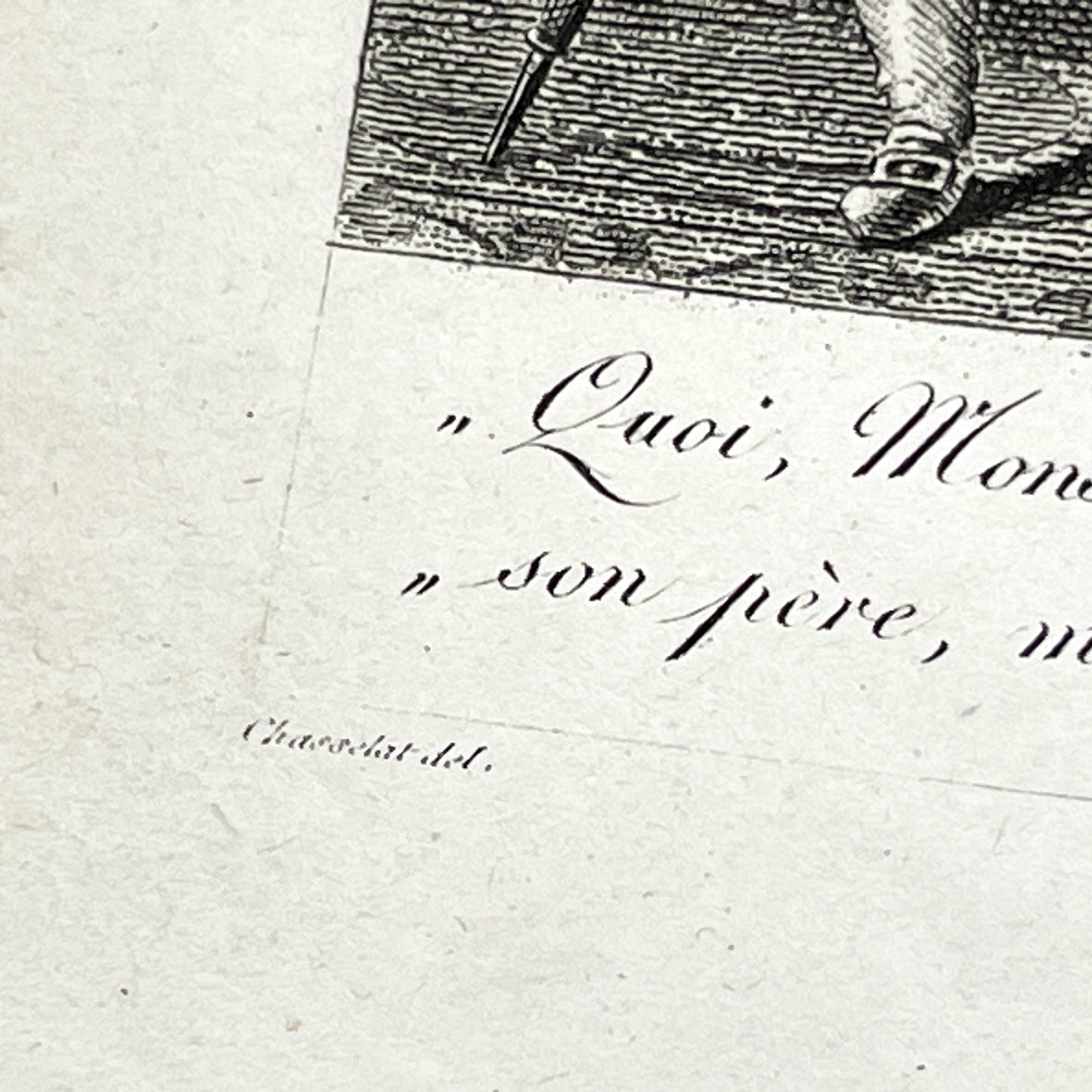
Below the central image, a fragment of dialogue in French adds narrative intrigue to the scene. It reads: 'Quoi, Monsieur, vous seriez!.... — son père, mademoiselle.' This translates to 'What, Sir, you would be!.... — her father, young lady.' This exchange hints at a moment of surprise or revelation, suggesting a story or play from which this illustration might have been drawn. The title 'Le Cachemire' could refer to a valuable shawl, a popular accessory of the time, or perhaps a metaphorical element within the narrative. The detailed cross-hatching and shading techniques employed in the engraving highlight the mastery of the printmaker, bringing life and emotion to the characters' expressions and gestures. This piece offers a charming glimpse into the social customs and artistic sensibilities of the early 19th century.
This engraving was designed by Charles Abraham Chasselat (1782–1843), a talented French painter and illustrator active during the early 19th century. It was engraved by one or more anonymous engravers working in Paris and published around 1815–1820, during the late Empire or early Restoration period. Prints of this type typically appeared in refined illustrated books such as Scènes de la vie domestique, Scènes intéressantes de la vie privée, or Contes moraux illustrés — popular collections that combined moral storytelling with delicate visual interpretation. These works reflected the sentimental and didactic spirit of the time, portraying scenes of virtue, affection, and everyday emotion within elegant bourgeois or domestic settings.
Below the central image, a fragment of dialogue in French adds narrative intrigue to the scene. It reads: 'Quoi, Monsieur, vous seriez!.... — son père, mademoiselle.' This translates to 'What, Sir, you would be!.... — her father, young lady.' This exchange hints at a moment of surprise or revelation, suggesting a story or play from which this illustration might have been drawn. The title 'Le Cachemire' could refer to a valuable shawl, a popular accessory of the time, or perhaps a metaphorical element within the narrative. The detailed cross-hatching and shading techniques employed in the engraving highlight the mastery of the printmaker, bringing life and emotion to the characters' expressions and gestures. This piece offers a charming glimpse into the social customs and artistic sensibilities of the early 19th century.
This engraving was designed by Charles Abraham Chasselat (1782–1843), a talented French painter and illustrator active during the early 19th century. It was engraved by one or more anonymous engravers working in Paris and published around 1815–1820, during the late Empire or early Restoration period. Prints of this type typically appeared in refined illustrated books such as Scènes de la vie domestique, Scènes intéressantes de la vie privée, or Contes moraux illustrés — popular collections that combined moral storytelling with delicate visual interpretation. These works reflected the sentimental and didactic spirit of the time, portraying scenes of virtue, affection, and everyday emotion within elegant bourgeois or domestic settings.
Explore more from our antique engravings collection .
💬 Questions before or after purchase? We’re always happy to help.