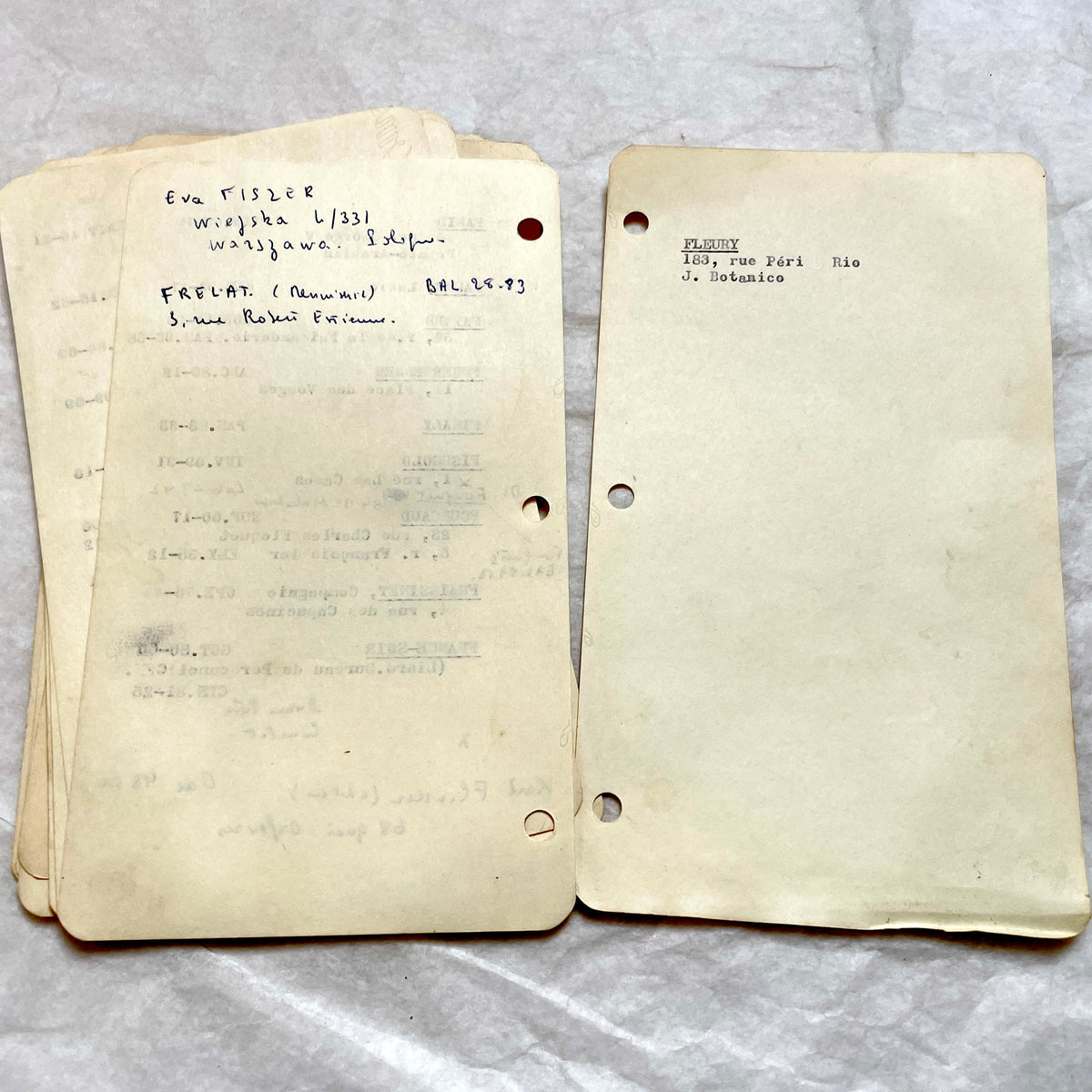


1950s - Mid 20th - Paris Elite Address File - Chanel Dior Bresson Balthus Auric Druon - Cultural Network Archive Cards
1950s - Mid 20th - Paris Elite Address File - Chanel Dior Bresson Balthus Auric Druon - Cultural Network Archive Cards
Sold
Taxes included.
Shipping calculated at checkout.
🕰️ Vintage from the 1950s
🤍 Handpicked by Vincent
📐 Dimensions: 18x11 cm (7.1x4.3 in)
📦 Carefully packed and shipped worldwide
🔒 Secure Shopify checkout · Credit cards, Apple Pay, Shop Pay, PayPal
🧾 Shipping & returns details
ℹ️ Shipping costs depend on destination and weight and are always shown clearly before payment.
Couldn't load pickup availability
An exceptional mid-20th century Parisian address index archive revealing a remarkable network of cultural, artistic, and high-society figures. This rare collection of typed index cards offers a unique glimpse into the interconnected world of postwar Paris, where cinema, fashion, literature, and diplomacy converged within an elite social fabric.
Carefully organized and typed, these cards document names and prestigious addresses across Paris and beyond, forming a tangible map of influence and relationships. What elevates this archive far beyond a simple contact file is the presence of numerous historically significant personalities whose names shaped 20th-century culture.
Among them appears Robert Bresson, one of the most influential French film directors, associated with his Quai Bourbon address. The presence of Balthus, the internationally renowned painter, further anchors this collection within the highest circles of modern art. The composer Georges Auric, member of the celebrated group “Les Six” and prolific film score composer, reinforces the strong connection to the cinematic and musical avant-garde.
The world of fashion is powerfully represented through entries for Chanel, located at the iconic 31 rue Cambon, and Dior, symbolizing the golden age of Parisian haute couture. These references place the archive directly within the orbit of luxury and design history.
Literary and intellectual prestige is embodied by Maurice Druon, member of the Académie Française and celebrated author, alongside Edmonde Charles-Roux, journalist, writer, and future Prix Goncourt laureate. Their presence highlights the deep ties between media, literature, and Parisian high society.
The archive also connects to major cultural and commercial institutions. The name Cassandre, legendary Art Deco graphic designer, appears alongside Marcel Bleustein-Blanchet, founder of Publicis and a key figure in modern advertising. The influential Bernheim family, renowned art dealers associated with Impressionist masters, further emphasizes the artistic significance of this network.
International and institutional connections are equally evident, with references to the UNESCO, Agence France-Presse, France-Soir, and diplomatic entities such as the Embassy of Afghanistan and links to American media through NBC. These elements reveal a global dimension extending well beyond Paris.
Altogether, this archive stands as a rare and evocative document of a vanished world—an authentic cross-section of mid-century Paris where creativity, influence, and prestige intersected. It is a compelling piece for collectors of historical documents, cultural archives, and anyone fascinated by the hidden networks behind iconic names.
Carefully organized and typed, these cards document names and prestigious addresses across Paris and beyond, forming a tangible map of influence and relationships. What elevates this archive far beyond a simple contact file is the presence of numerous historically significant personalities whose names shaped 20th-century culture.
Among them appears Robert Bresson, one of the most influential French film directors, associated with his Quai Bourbon address. The presence of Balthus, the internationally renowned painter, further anchors this collection within the highest circles of modern art. The composer Georges Auric, member of the celebrated group “Les Six” and prolific film score composer, reinforces the strong connection to the cinematic and musical avant-garde.
The world of fashion is powerfully represented through entries for Chanel, located at the iconic 31 rue Cambon, and Dior, symbolizing the golden age of Parisian haute couture. These references place the archive directly within the orbit of luxury and design history.
Literary and intellectual prestige is embodied by Maurice Druon, member of the Académie Française and celebrated author, alongside Edmonde Charles-Roux, journalist, writer, and future Prix Goncourt laureate. Their presence highlights the deep ties between media, literature, and Parisian high society.
The archive also connects to major cultural and commercial institutions. The name Cassandre, legendary Art Deco graphic designer, appears alongside Marcel Bleustein-Blanchet, founder of Publicis and a key figure in modern advertising. The influential Bernheim family, renowned art dealers associated with Impressionist masters, further emphasizes the artistic significance of this network.
International and institutional connections are equally evident, with references to the UNESCO, Agence France-Presse, France-Soir, and diplomatic entities such as the Embassy of Afghanistan and links to American media through NBC. These elements reveal a global dimension extending well beyond Paris.
Altogether, this archive stands as a rare and evocative document of a vanished world—an authentic cross-section of mid-century Paris where creativity, influence, and prestige intersected. It is a compelling piece for collectors of historical documents, cultural archives, and anyone fascinated by the hidden networks behind iconic names.
Explore more from our antique documents collection .
💬 Questions before or after purchase? We’re always happy to help.