

1860s - Antique French Hand-Colored Fashion Plate - Journal des Demoiselles - Victorian Dress Print - 1868 Paris Art
1860s - Antique French Hand-Colored Fashion Plate - Journal des Demoiselles - Victorian Dress Print - 1868 Paris Art
Regular price
€18,00 EUR
Regular price
Sale price
€18,00 EUR
Unit price
per
Taxes included.
Shipping calculated at checkout.
🕰️ Vintage from the Mid 19th century
🤍 Handpicked by Vincent
📐 Dimensions: 29x20 cm (11.4x7.9 in)
📦 Carefully packed and shipped worldwide
🔒 Secure Shopify checkout · Credit cards, Apple Pay, Shop Pay, PayPal
🧾 Shipping & returns details
ℹ️ Shipping costs depend on destination and weight and are always shown clearly before payment.
Couldn't load pickup availability
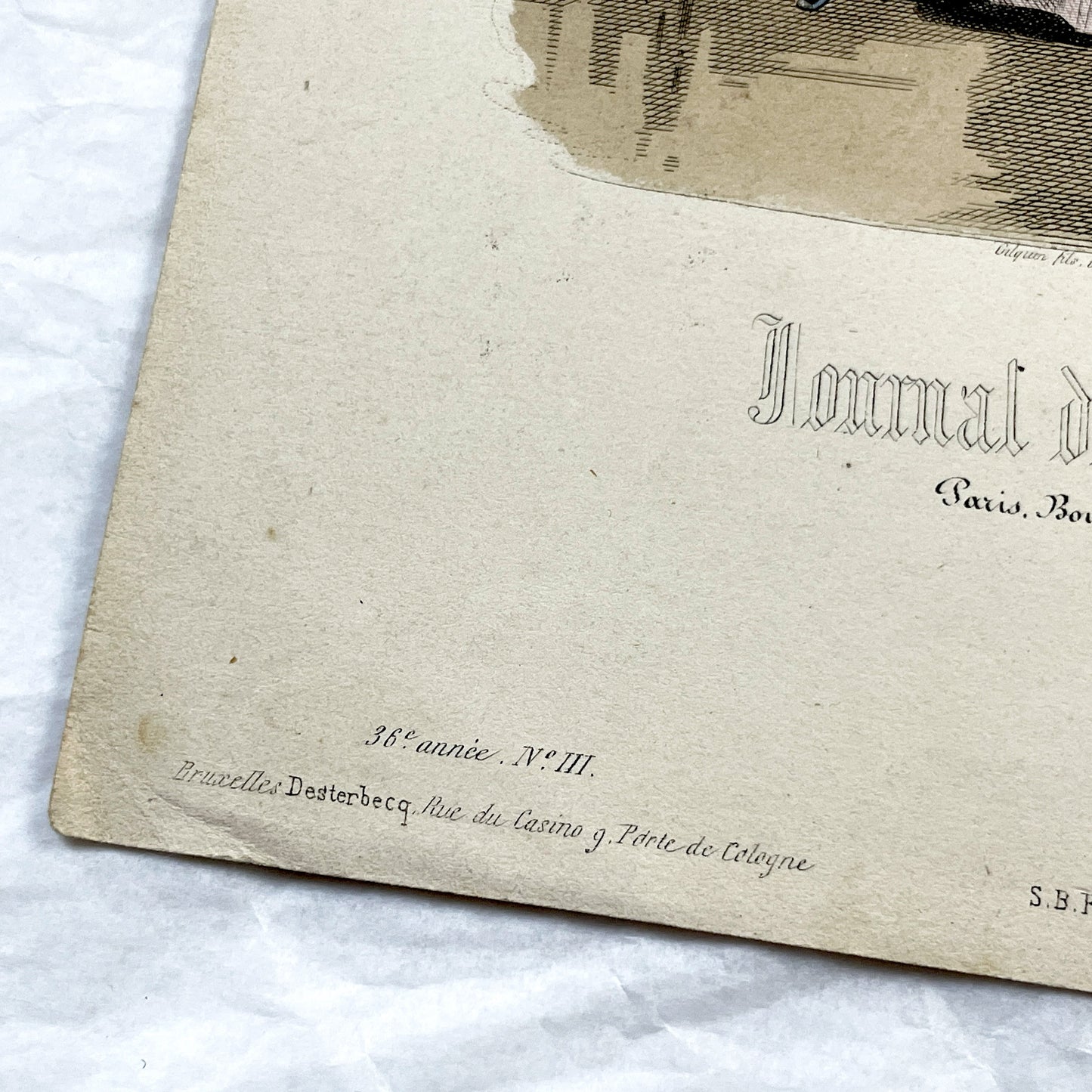
This original hand-colored fashion plate dates back to March 1868, extracted from the renowned "Journal des Demoiselles." This influential French magazine was a staple for women's fashion throughout the 19th century, known for its elegant illustrations.
The plate showcases three figures in detailed Victorian attire: a woman in a sophisticated blue walking coat, another in a charming light-colored gown with prominent pink ribbons and trim, and a young child in a blue suit holding a doll. The artistry captures the essence of Parisian style during this opulent era.
Printed by Delpech fils in Paris, with distribution noted in Brussels, London, and Amsterdam, this piece offers a glimpse into European fashion dissemination.
Please note that this engraving is not in impeccable condition, please take a good look at the photos.
Dimensions: About 29 x 20 cm
Techniques of realization:
From circa 1850 to 1880, issues of Journal des Demoiselles featured elaborate fashion plates produced using traditional engraving or lithography, then hand‑colored, creating unique, richly detailed images for readers. The black‑ink outlines—often etched or engraved—were printed first, after which skilled colorists applied watercolors directly to each print.
Occasionally, simple tonal effects were added using techniques like aquatint or stipple engraving for dimension before hand‑coloring. Art historical sources confirm that these mid‑19th‑century illustrations were deliberately enhanced by artisans to showcase the latest Parisian styles with artistic refinement and individual character
Journal des Demoiselles history:
Founded in February 1833 in Paris by Jeanne‑Justine Fouqueau de Pussy, the Journal des Demoiselles was a leading French magazine aimed at teenage girls (14–18 years old), catering to middle‑ and upper‑class audiences . Initially issued in two versions—one illustrated and one text-only—it evolved by 1865 into multiple editions distinguished by color (including purple, blue, green), with a new weekly “orange” edition added in 1869 .
Targeted at young women, the journal featured a variety of content: fashion plates, literature, moral advice, theatrical reviews, and practical topics like sewing and etiquette, with limited emphasis on science or education . It absorbed other publications over its lifespan—including Petit Courrier des Dames in 1869, La Jeune Fille de Bruxelles in 1902, and La Lecture in 1913—before ceasing publication in 1922 .
The Journal des Demoiselles was highly regarded for shaping the tastes and values of young French women across nearly a century. Its beautifully presented fashion imagery and cultural features made it a fashionable household name. The variety of editions and long publication run reflect its enduring influence in 19th- and early 20th-century French society.
The plate showcases three figures in detailed Victorian attire: a woman in a sophisticated blue walking coat, another in a charming light-colored gown with prominent pink ribbons and trim, and a young child in a blue suit holding a doll. The artistry captures the essence of Parisian style during this opulent era.
Printed by Delpech fils in Paris, with distribution noted in Brussels, London, and Amsterdam, this piece offers a glimpse into European fashion dissemination.
Please note that this engraving is not in impeccable condition, please take a good look at the photos.
Dimensions: About 29 x 20 cm
Techniques of realization:
From circa 1850 to 1880, issues of Journal des Demoiselles featured elaborate fashion plates produced using traditional engraving or lithography, then hand‑colored, creating unique, richly detailed images for readers. The black‑ink outlines—often etched or engraved—were printed first, after which skilled colorists applied watercolors directly to each print.
Occasionally, simple tonal effects were added using techniques like aquatint or stipple engraving for dimension before hand‑coloring. Art historical sources confirm that these mid‑19th‑century illustrations were deliberately enhanced by artisans to showcase the latest Parisian styles with artistic refinement and individual character
Journal des Demoiselles history:
Founded in February 1833 in Paris by Jeanne‑Justine Fouqueau de Pussy, the Journal des Demoiselles was a leading French magazine aimed at teenage girls (14–18 years old), catering to middle‑ and upper‑class audiences . Initially issued in two versions—one illustrated and one text-only—it evolved by 1865 into multiple editions distinguished by color (including purple, blue, green), with a new weekly “orange” edition added in 1869 .
Targeted at young women, the journal featured a variety of content: fashion plates, literature, moral advice, theatrical reviews, and practical topics like sewing and etiquette, with limited emphasis on science or education . It absorbed other publications over its lifespan—including Petit Courrier des Dames in 1869, La Jeune Fille de Bruxelles in 1902, and La Lecture in 1913—before ceasing publication in 1922 .
The Journal des Demoiselles was highly regarded for shaping the tastes and values of young French women across nearly a century. Its beautifully presented fashion imagery and cultural features made it a fashionable household name. The variety of editions and long publication run reflect its enduring influence in 19th- and early 20th-century French society.
Explore more from our antique engravings collection .
💬 Questions before or after purchase? We’re always happy to help.